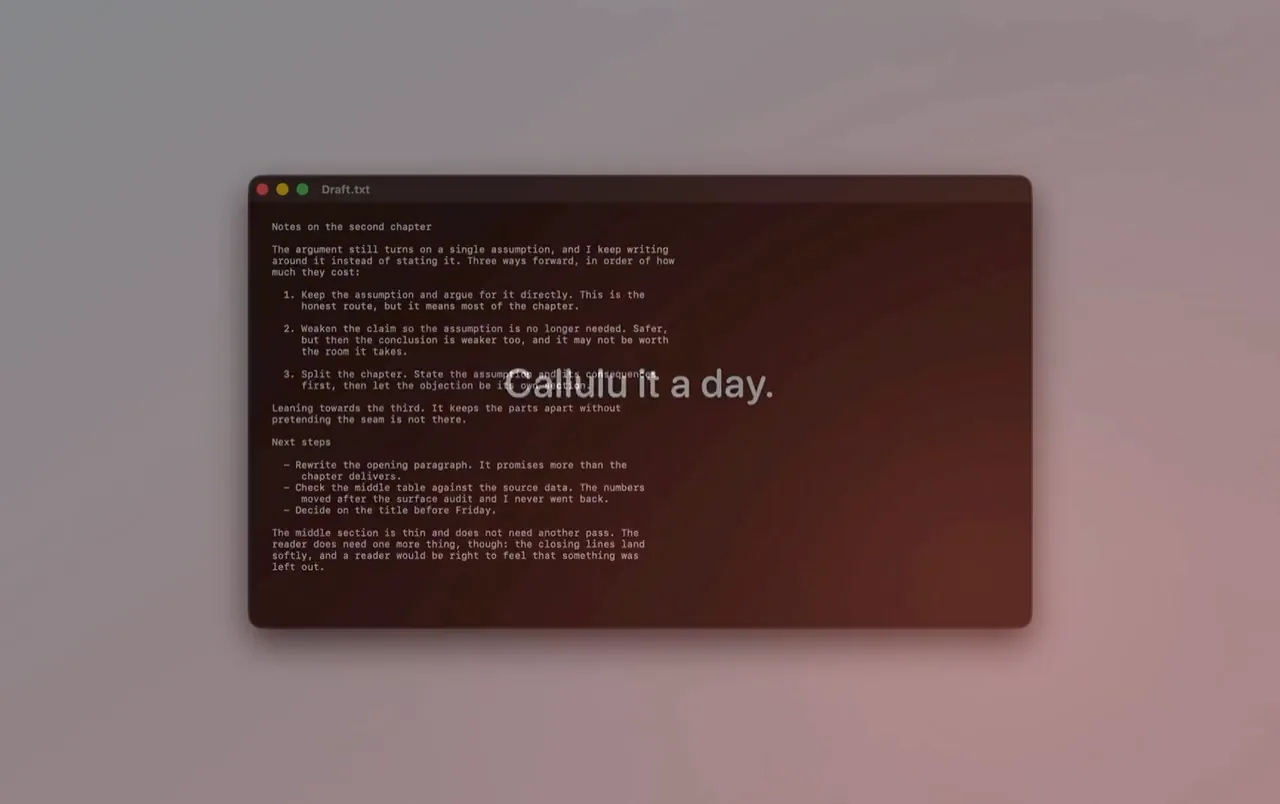
Around the third year of working from a laptop at home, I noticed that the rule I kept setting for myself had never once worked. "I will stop at seven" sounded reasonable at noon. By seven there was always a reason it did not apply tonight: one more reply, one more pass at the thing I had put off all day, a build finishing in the background that I might as well wait for. The rule was fine as a sentence. It was being asked to hold at an hour it was never made for.
The promise made at noon, kept at midnight
A rule about stopping is a decision made in advance, to be carried out later by a person who no longer has the view that made it sound reasonable. At noon I can see the whole day and weigh an evening against it. At seven, or nine, or eleven, I can only see the screen in front of me, and the screen always looks a little more finishable than it is. The person enforcing the rule is not the person who made it. For years I treated that as a willpower problem. It is a timing problem.
An alarm leaves that part where it was. It sounds at the hour the rule named, the absorbed brain gives it five minutes, and five minutes becomes the rest of the night.
Changing what the evening looks like, not what it's told
What changed something for me was making the end of the day visible in the room itself, so there was nothing to decide and nothing to remember. A popup asking me to confirm I was done is still a question, and a question can be argued with. I wanted something closer to a room getting darker as the sun goes down, whether or not you were watching for it.
The screen is where the work happens, so the screen is where the signal has to be. If the only thing marking the end of the day is a clock somewhere else, a phone, a calendar, someone asking whether I am coming down, it competes with everything that is lit up and waiting for a reply, and it rarely wins. If the surface I am staring at changes, I do not have to notice a signal and then act on it as two separate steps.
I built this into Callulu, the small Mac app I make, as a cue called LUNA. When it is on, the whole screen softens gradually, and it goes on softening while I work. Clicks pass straight through it to the window underneath, so the app I am in keeps taking them. You choose the time it starts, and it stays until you turn it off. How far the softening goes is a setting, and the cue can be switched off on its own. It does not know what you are working on and it does not stop you from working through it. You can keep typing while the screen dims around you, and some nights I do.
That is the limit of it. A gradual dimming did not end my habit of working late. It moved the decision earlier, into a moment when the screen is doing some of the arguing instead of me doing all of it alone at eleven at night.
The part that happens away from the screen
A dimmer screen still leaves a body at a desk. I learned that slowly, by running LUNA for months while I sat in the dim glow and kept typing. The cue changes what the screen looks like. It does not move anyone. What made the difference was pairing it with one small physical act I had agreed to in advance: closing the lid, or standing up and walking to another room. As an end-of-workday routine, the order matters: the softened screen comes first, and it is the trigger for the part that costs something.
I do not have this solved. Some nights the lid stays open, softened screen and all, because whatever I am doing feels too close to finished to leave. I no longer expect a cue, an app, or a firmer rule to close that gap on its own. On those nights the screen dims around me anyway, and I stop later than I meant to.